AEGIS
A drone detection system I developed at Ineco. It only detects, with a human in the loop and no countermeasure capability, and it abstains when the sources contradict each other.
A drone, a bird, clutter and an empty sky cannot always be told apart with what comes in from the sensors, and sometimes the sensors do not even agree with each other. A system that always answers with confidence ends up giving wrong answers with the same confidence.
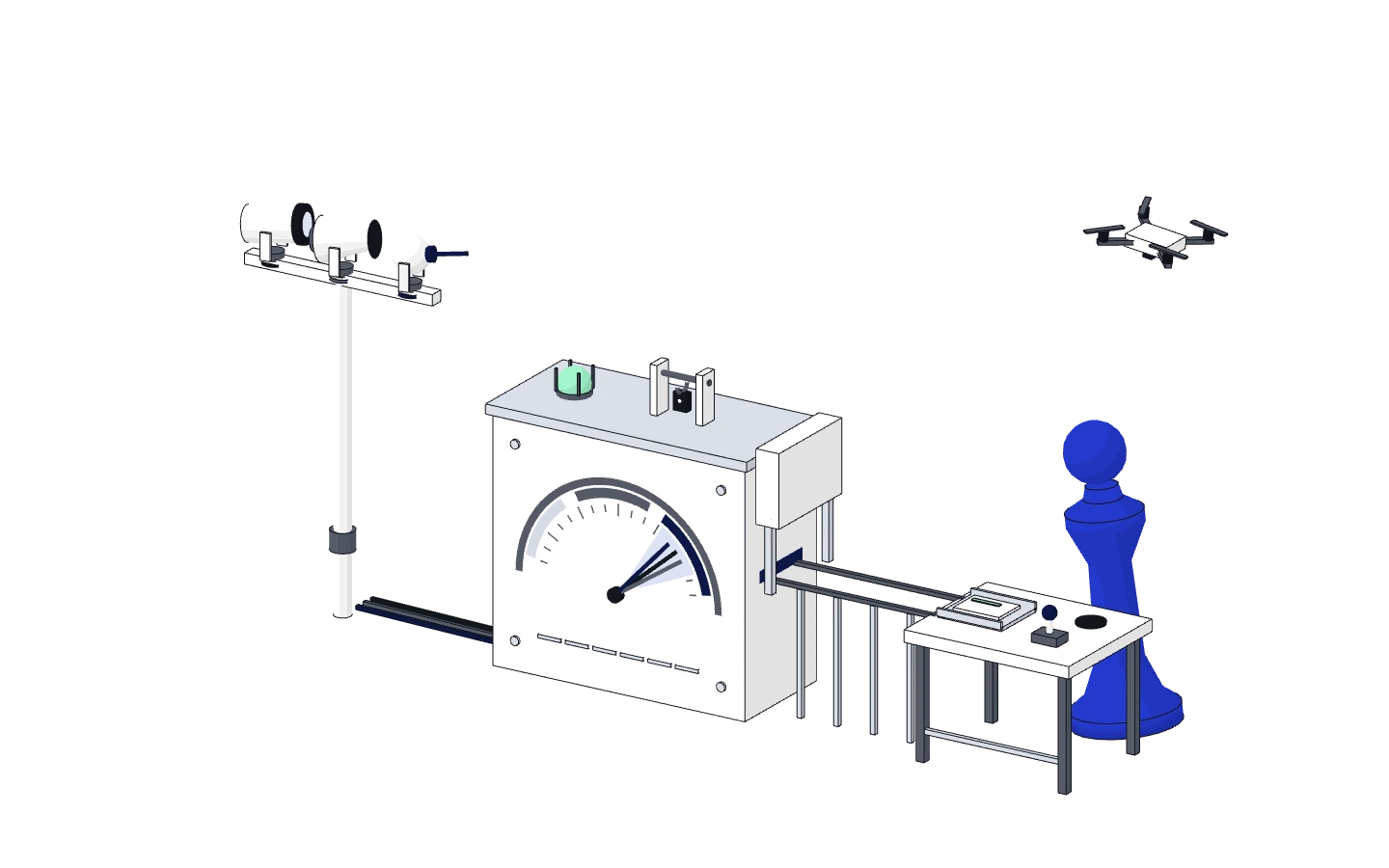
AEGIS is a system I developed at Ineco to detect drones and alert a person. It does nothing else. It has no countermeasures, it cannot target anything, and that person makes every decision. It is designed to know when it does not know, and to say so.
Keeping the doubt
The system combines what several sources say regardless of the order they arrive in, and when they disagree it keeps the doubt instead of hiding it. In the jargon, order-invariant n-ary evidential fusion, with the PCR6 rule.
Under conflicting sources and at equal discrimination, that fusion keeps more declared ignorance than combining the sources two at a time. Ignorance is rarely something to show off, and here it is precisely what gets measured.
A set instead of a point
Each object is tracked with a set that is guaranteed to contain its position, instead of a single point (zonotope tracking). The guarantee was validated against real flight trajectories, including aggressive fixed-wing manoeuvres that break the tracker’s own acceleration assumptions in 10 to 13 % of ticks.
While it runs, the system checks bounded temporal-logic safety properties and measures its calibration with an explicit outcome for abstaining. Every run is deterministic under a fixed seed and is written to a hashable audit trail, so results reproduce bit for bit on any platform.
I am the author of the preprint, which is on Zenodo with the reference implementation, the synthetic testbed, the real-flight experiments and the documentation.
The preprint also states its measured limits. The width of the sets does not depend on the data, the consistency monitor only checks position, and velocity is weakly observable. A system built to know when it does not know starts by saying so about itself.